
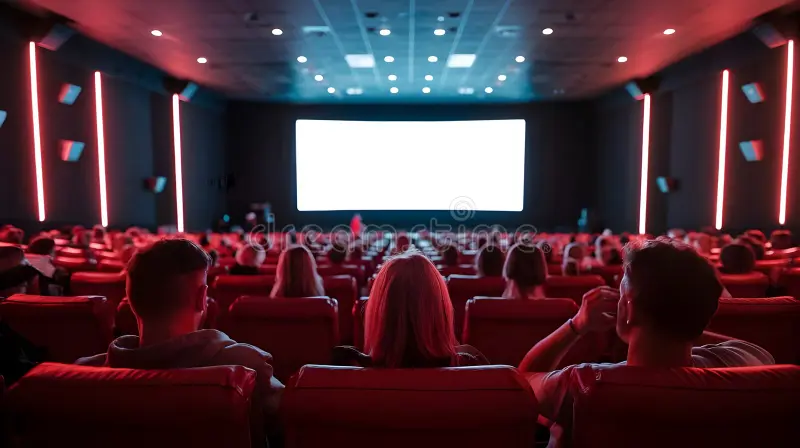
[Above] Many people gather to watch a movie in a modern theater
![Above] Many people gather to watch a movie in a modern theate](https://thumbs.dreamstime.com/b/movie-theater-audience-watching-blank-screen-wide-shot-movie-theater-audience-watching-blank-movie-screen-audience-336986857.jpg)
Ever since my childhood, I, along with many others in the world enjoyed watching movies, both in theaters and on my home TV or computer. My all-time favorites include Dragon Ball Super: Broly, Star Wars: Revenge of the Sith, Aladdin, The Lion King, The Incredibles, The Avengers: Endgame, and Iron Man. Pretty cool, right? However, I wouldn’t be all too surprised if you disagree with me, even though these movies are all critically and commercially successful. Everyone in the world has their own favorite movies, and I may or may not agree with your tastes, which is absolutely OK. However, what I do have a problem with is when people childishly put each other down when they disagree about movie tastes while conflating facts and opinions. For example, people label certain movies they like as “good,” or movies they don’t like as “bad,” while the opposite is true for another person. Take away the clear bias, what really makes a movie “good” or “bad?”
What Makes a Good Movie?
Movies are a central form of entertainment today for the majority of the population. There is no singular right answer to why we love them so much, as a person’s reason to enjoy anything is mostly subjective. The only problem is, if you told this to a film critic, it would end their career, as their jobs are to “objectively” rate movies based on how well they’re made, in terms of acting, cinematography, visual effects, scripting, dialogue, choreography, animation, sound design, etc. This is important because movies are also a business. Hence, the critics leave it to themselves to judge whether or not the audience should give up even a small chunk of their precious time and money to see them and to grade the producers on where they went wrong or got right. Some movies are universally loved, some widely hated, and others lukewarm. Despite how well a critic may rate a movie, one viewer may think it’s the scum of all movies, or vice versa. The disagreement between audiences and critics on a movie’s quality can create confusion and indecision in unfamiliar audiences because one side sees a good movie, the other a bad one. However, if reviews and public opinion are the only reasons to decide whether a movie is worth watching, we would live in a completely different world. This is where marketing ploys like trailers, ads, celebrity casting, nostalgia, and merchandise hit the scene. Producers try to rope in audiences to get them to watch their movies by taking advantage of their emotional monkey brains pointing them towards whatever they like, regardless of any consequences. It works for the industry because when movies are marketed well and rope in a good audience, more people will be compelled to watch them. Critics sort of police the audiences so that they know what to expect from the movie, whether general audiences end up liking it or not. Only after seeing the movie for themselves can the viewers formulate their actual opinion of the movie. Today we will dive into the statistics and get to the bottom of what decides a good movie.
Red (Netflix) is the New White (Crack)
Nowadays, many people watch them on streaming apps like Netflix, which demands a fixed paid subscription in exchange for conveniently watching one of the thousands of movies or shows you want anytime. Because of such power, it gives users, get hooked on watching shows and movies on it like crack. It’s different from going to the movies because you can only do that at a specific time of day, you would need to book seats or tickets, and the like, which creates some friction. With Netflix, however, you can just get bored and put on a movie or show willy-nilly. To throw salt in the wound, you may know that feeling when binging a series and you tell yourself “Just one more episode and I’m all done.” the next minute, you cave in and time skips itself three hours past your bedtime.

As a result of this experiment, many movies marketed as “Netflix Originals” rallied Netflix addicts to watch them for hundreds of millions of hours collectively. The greatest offender is Red Notice, the most expensive Netflix-only film second only to 2023’s Gray Man. It starred A-list actors such as Ryan Gosling, Gal Gadot, and the one and only Dwayne “The Rock” Johnson, which greatly contributed to the film’s marketing success. This is because the average Netflix watcher’s reptilian brain gets riled up by a familiar face and thinks “OMG the Rock is in this one!” and clicks away to put on Red Notice. This is only a singular example, as another factor of Netflix movies growing to be as popular as they are is having a shocking theme, such as in Bird Box, which was about a mysterious entity that causes unsuspecting victims to lose their sanity and take their own lives minutes within seeing it. Because suicide is already such a grave topic, it made the stakes of Bird Box all the more intriguing. Combine that with casting Sandra Bullock as a lead and then Netflix’s addictive nature and optimal marketing, and then you’ve got yourself a deadly trifecta. The absurdly high viewership of movies like these does not mean these movies are good, as their critic and consumer ratings say otherwise.
Are Netflix Movies Even Good?
To answer the question of whether a movie is considered “good,” one would need to see how it holds up in the eyes of both critics and audiences. Critics grade the quality of movies as their job and have a ton of experience doing so, hence they are seen as qualified. Because of this, people when they wonder if a movie they hear about is worth watching, they classically look at critic scores so they know what to expect. After seeing it, the viewer decides how much they like the movie, irrespective of its quality. User scores are arguably a more useful way to see if a movie is considered “good” because it shows how well the movie appeals to its target audience. Because of the ability to publish one’s personal opinion on movies and other media due to the internet, critic scores are fading out of relevancy in this day and age. Moreover, neither side is free of bias, so comparing the scores is crucial.

For example, the top Netflix movie as of 2022, Red Notice was notably poorly received by critics, doling out a Metacritic score that falls into the “unfavorable” range, and met relatively mediocre reception by Google users. This shows that Red Notice did not quite live up to the expectations set by its marketing and casting. Therefore, not too many people see it as a “good” movie. On the other hand, the mystery film, Enola Holmes starring Millie Bobby Brown was well-liked by both critics and its audience. High ratings from both parties show that the movie succeeded in both quality and appeal to its target audience. Enola already had a target audience in mind and source material to work off of, which were the Enola Holmes novels, so the film’s production, direction, casting, marketing, and writing were tooled accordingly. This led to Enola Holmes being widely considered a “good” movie. When someone says “good movie” in an everyday conversation, they usually mean that they enjoyed it themselves, not necessarily that it was made well. Even when a large number of people agree that they like a movie, there is still bound to be a minority that thinks such a movie is “bad,” showing that the label of “good” movies comes down to subjective opinion.
What About BlockBusters?
There’s a 90% chance that whoever is reading this has been to, or at least walked near a movie theater. But just in case you forgot, it’s a basically place where you sit down (or recline) in a big dark room next to dozens of other people to watch a movie on a gigantic screen. We already talked about Netflix movie viewership, but it’s also worth diving into the details about movies in theaters. Netflix is different, because you pay a fixed subscription fee to watch as many movies as you want anytime, but in theaters, you need to plan carefully the time of day you sacrifice 2-3 hours out of your day and then book a good seat and pay for a ticket accordingly. You should also decide in advance if the movie is worth watching before possibly turning your whole day upside down just to see it. The differences in convenience and processes to do this significantly affect the decision-making process, as Netflix watchers are far more likely to impulse-watch a movie than theater-goers.

As you can see here, Star Wars: The Force Awakens is the single highest-grossing movie in the USA. Its commercial success may likely be attributed to the cultural impact and mass appeal of the Star Wars franchise in general. The fanbase anticipated a sequel to the original trilogy ever since entertainment titan Disney acquired the Star Wars franchise, propelling everyone who has heard “Star Wars” at least once and their mother to flock to the box office to watch The Force Awakens. The majority of the highest-grossing movies are also part of already successful fictional franchises with mass appeal, showing that audiences are more likely to plan to sacrifice up to 1/8th of their day to movies they are relatively more confident they will enjoy, as opposed to watching something random. Additionally, more than half of these movies are owned by Disney, whose movies most Americans grew up watching, adding to the familiarity factor.
How do Big Screen Movies Hold Up Against Netflix?

We went over how top-viewed Netflix movies are a mixed bag in terms of critical and consumer ratings, however, this pattern is not as stark when you look at top-grossing box-office movies. This is likely because movie theaters lack the addictive nature of Netflix, and do not rely on computerized algorithmic recommendations as much. When a theater movie is disliked by the masses, people are quicker to notice it, and it leads to such a movie losing viewership, which causes theaters to lose business. Hence, they need to keep showing well-liked movies that people are more likely to take out their time to watch. On the contrary, Netflix uses movie suggestion algorithms based on its users’ online activity to get users hooked to the app by suggesting movies that appeal to their monkey brains. Because they can take advantage of impulse-watching movies, Netflix cares less about whether or not their original films are unanimously praised, because they get money through subscriptions anyway. Most of the top 25 box office movies consistently have either high critic or audience ratings, unlike the top Netflix films, which had mostly lukewarm critic and audience reception.
Netflix Addiction

Let’s face it. Netflix is designed to keep you hooked. Its movies’ popularity is most attributed to how well they are marketed, hyped up, and then recommended to unsuspecting users. It doesn’t matter which movies gain traction, because the money comes in through subscriptions and users can watch however many movies they please. Because of this, Netflix addictions are on the rise, paving the way for the Netflix corporation to rake in more publicity, leading to greater subscription purchases, which equal larger profits. It’s not just movies Netflix uses to entice netizens, it’s also TV shows, which are far easier to fall into a binge of watching. To make matters worse, the deeper you get into the Netflix rabbit hole, the less you care if the movie is entertaining, because watching an overhyped mediocre film or TV show is better than nothing. Without it, you would feel unbearably bored. If you struggle with a Netflix addiction, I suggest you take a break from using it, maybe cancel your subscription so that you can let your brain recover from Netflix burnout. Why are we talking about addictions in a paper about movie reviews? Netflix addictions are part of the reason their most viewed original films have mostly mixed or negative reception.
Quality over Quantity

[Above] Stock image of 3 teenagers bonding and enjoying a movie in theaters together
We went over how movies in theaters are relatively harder to take time to watch, but are better experiences compared to Netflix’s films, but more factors make them hit differently. See, when you find yourself seeing movies in theaters less often than you would likely watch Netflix, you would naturally appreciate the experiences more. Another thing is that theater-goers watch films with their family and friends, making for a wholesome bonding experience regardless of whether they end up liking the movie or not. Moreover, you need to make informed decisions on movies for which you need to go to a specific place at a specific time to see because no one wants to waste their day on a boring movie. Because you see movies in theaters less often, theater experiences are like quality time, as opposed to watching Netflix, which is only quantity time. Now, this ties back into the quandary of what makes a movie good, because it all comes down to subjective opinion, which can be shaped by pleasurable experiences associated with the movie. For example, I went to see The Super Mario Bros Movie with my family and enjoyed it for its action, humor, faithfulness to the source material, story premises, and animation, with your joy magnified by having my family right there enjoying it with me. I felt it was right to call it a good movie without hesitation. Let’s say I decided to watch it on Netflix while doing homework out of mere boredom. In a moment like that, the Mario movie would not have been nearly as enjoyable as seeing it in theaters, because, in that moment, it’s just a background movie that I just put on for no reason, instead of an alluring masterpiece I savor every moment watching.
![[Above] Stock image of 3 teenagers bonding and enjoying a movie in theaters together](https://media.istockphoto.com/id/1522056968/photo/happy-girls-watching-a-surprising-movie-in-theatre.jpg?s=612x612&w=0&k=20&c=1OIsCH1lOJ-Y7-GGydOBJkcSw_VL3-mAt-nwvOGe2fY=)
Works Cited
https://www.rottentomatoes.com