
From mass shootings to smaller domestic gun crimes, the toll of gun violence has stretched all over America, remaining a prevalent and complex issue which impacts communities worldwide. But one fact continues to be ignored: gun laws save lives.
Gun violence is a preventable tragedy but still stands as one of the main causes of death across the United States. In 2022, 48,204 individuals died due to interactions with firearms, with suicides being the leading cause of gun violence fatalities. Apart from suicides, other instances include homicides, legal interventions, and unintentional injury/shootings.
There is an average of one death and almost 200 nonfatal injuries due to gun violence in America every 11 minutes.
Another study shows that there was a 22% rise in gun-related fatalities from 2019 to 2022, and in 2023 an average of 118 individuals died from gun-related incidents per day. For every individual that dies from gun violence, two survive and carry costly and extraneous injuries, totaling to 100,000 people wounded by guns yearly. Between January 1 and July 2, 2024, over 261 mass shootings took place. In the years between 2018 and 2023, there was an average of 603 mass shooting events.
To start with the leading cause of gun violence fatalities, we have to tackle the subject of suicide. The majority of people who attempt suicide do not succeed, and it is estimated that only 5% of suicide attempts are actually successful. However, when looking at suicide attempts that utilize guns, upwards of 90% of them are fatal. The US gun suicide rate is 12 times that of other developed countries, and within the US the rate of gun suicide is 2.5 times higher in rural regions than urban ones. In fact, suicide-by-gun accounts for less than 5% of attempts, but more than half of fatalities. While part of the solution to this problem must come from investment in mental health, simple policy solutions like mandatory safe storage, red flag laws, and waiting periods for purchasing guns go a very long way. Still, this problem is something that plagues this country and shows no signs of abating.
Beyond those facing mental health problems, another particularly vulnerable population within the US disproportionately affected by gun violence are women who often become victims of domestic violence (DV). 4.5 million women across the US have reported being threatened with a firearm by an abusive partner. However, guns are not just used by abusers to threaten their partners. An analysis of CDC data finds that 7 in 10 DV homicides in the United States every year are committed using a firearm and that nearly three-fourths of the victims of those homicides are women. Women who live with an abusive partner are 5 times more likely to be murdered by that partner if there is a gun present within the household. Notably, this statistic does not hold for men living with abusive partners, meaning that women are, year after year, disproportionate victims of DV homicides involving firearms. In fact, women in the United States as a whole are 28 times more likely to be murdered using a gun than women in other developed nations.
Statistics about gun violence’s impact on women and DV victims are rightly horrifying. However, guns pose an even bigger threat to children and adolescents in America. Gun-related deaths surpassed motor vehicle accidents in 2020 as the top cause of death for individuals under 19. Among this age group, gun-related homicides acted as the main cause of death, and having access to a firearm in a home corresponds with an increased risk for homicide victimization.
A report published by the Johns Hopkins Center for Gun Violence Solutions found that of the 48,000 individuals who died from gun violence across the nation, 2,500 of those killed were children and teens in the age groups of 1 to 17. These trends are especially prevalent in demographic groups like Black and Latino youth. Black youth from the age of 1 to 17 had a higher rate of gun homicide compared to white youth. Similarly, the homicide rate for Hispanic and Latino youth was three times higher than for white youth. Gun suicide rates are doubled for Hispanic and Latino youth (age 10-17) and are tripled among the Black youth (age 10-17). When expanding across all ages, American Indians and Alaskan Natives were five times more likely to die by gun homicide when compared to white people.
Another unsettling trend is seen in the rise of gun violence taking place in U.S schools. According to the National Institute for Health Care Management (NIHCM), there were 1,290 cases of gunfire on school grounds since 2013. The 2021-2022 school year had the highest number of gun-related incidents on campus and 144 incidents were reported in the 2023-2024 school year. Five children are lost for every 100,000 across the U.S and almost 3,500 die in gun-related incidents every year.
Beyond the devastating number of deaths, gun violence also stands as a major health problem, and has economic consequences in society and the healthcare system. The cost of gun violence in the U.S. is a staggering $557 billion annually. A majority of the costs include the quality-of-life costs, which involve pain and wellbeing lost by those injured and their families. An estimated $11 billion are allocated towards police and criminal justice, court processes, and incarceration. Following gun injury, medical spending increases by an average of $2,495 per month for adults and $2,907 per month for adolescents and children—$30,000 to $35,000 annually. Each death by a firearm impacts taxpayers as well, costing almost $274,000 and an annual average close to $1,700 per taxpayer. These unruly costs lead to a decline in financial stability in the United States. Premature death in younger working-class individuals impacts society by reducing the number of people in the labor force. Mass shootings also contributed to a decline of the economy. The prevention of incidents like this would assist in bolstering the economy and ease the economic burden.
Gun violence is also not something that starts and ends at state lines. Gun smuggling across state lines is a massive issue that can drive gun related crime and violence up even in states where gun laws are strict. The Iron Pipeline refers to the routes used in the US to smuggle guns from states with lax gun laws and enforcement (like in the Southeastern US) up to states with much stricter laws (like in Northeastern states). An investigation from the New York Times found that ⅔ of all the guns used in gun crime in NY and NJ came from out-of-state, and the majority of those out of state guns came from the South. Similarly, many of the guns used in crimes in Chicago come not from Illinois but from neigboring Indiana, where it is very easy to purchase one without a background check or waiting period. In fact, Everytown Research found that 78% of smuggled guns with short time-to-crime periods (meaning the period between purchase and usage in a crime) were purchased in non-strict states without background checks.
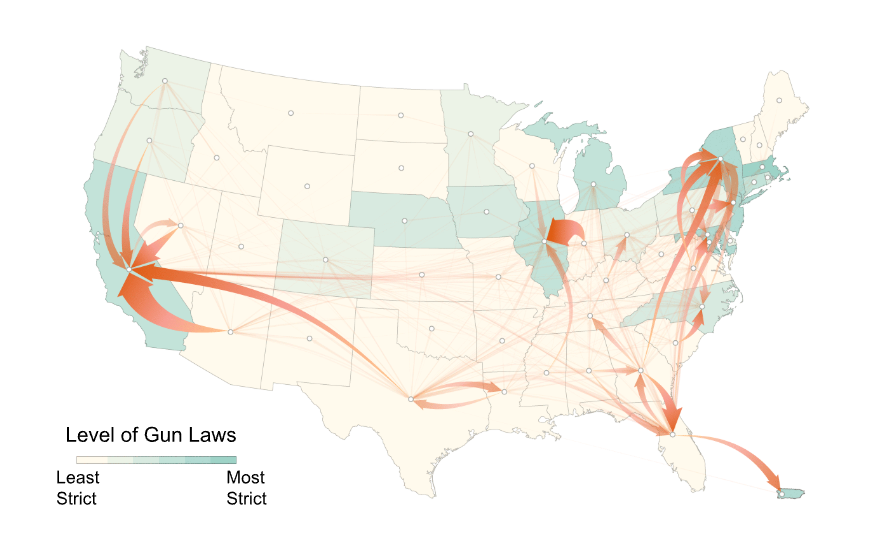
As a matter of fact, American issues of gun violence do not even stop at our own national borders. Many Latin American countries have major gun violence problems, despite many having quite strict laws regarding the legal acquisition of firearms. The reasons behind this prevalence of violence are multi-faceted and complicated, but one of the primary reasons is quite simple: millions of guns are smuggled into those countries across the US border - guns sold in the US and made by domestic manufacturers. Upwards of 70-90% of the guns used by cartels in Mexico are smuggled out of the US, and 7 out of the 10 most common gun brands seized from cartel groups by the Mexican military are American manufacturers like Colt, Winchester, and Smith & Wesson. Drug cartels like the Sinaloa and Gulf Cartels are responsible for much of the trafficking of narcotics into the US, including the increasingly deadly fentanyl. In other words, our own patchwork system of gun laws and lackluster enforcement keeps dangerous cartels that are responsible for drugs that kill thousands of Americans per year armed and dangerous.
States with high rates of firearm ownership drive the nation’s homicide rate. Several federal gun control measures are seen in the fine print, but the laws vary by state. The difference in these laws make it easier to obtain firearms in one state compared to another. For example, California has strict gun control laws and a homicide rate of 3.5 per 1000,000 people but Mississippi, which is a state known to be very gun friendly, has a gun homicide rate three times California’s. When examining gun laws in California, the state is ranked as the number one in the country for gun law strength by Everytown Research. The composite score is found by looking at the state’s foundational laws and finding the gun violence rate which is calculated by looking at the number of gun deaths per 100,000 residents. Some of the foundational laws include background checks/purchase permit, a required concealed carry permit, extreme risk law, no shoot first law, and a secure storage or child access prevention. Other laws monitor product safety, guns in public, keeping guns out of the wrong hands, policing and civil rights, and sales and permitting.
If every state had gun death rates similar to the “National Leader” states like California, New York, Illinois, Connecticut, etc., then approximately 298,000 lives could be saved in the next decade.
When looking over states ranked as having the top 50 gun safety policies, a trend starts to appear indicating that states with stricter laws have less gun violence. However, this outcome is debatable as states with strict gun laws, like Illinois and Maryland, experience a higher level of gun violence because of their populated cities and are often targeted by traffickers. Additionally, states like New Hampshire and Rhode Island seemingly have low gun death rates but are seen to have weaker policies, partly due to vigorous laws that exist among the other states in the region. Despite the importance of gun laws in each state, outlier states work against the trend, showing there are other factors that contribute to the numerous deaths that have plagued America.
The majority of states with the most gun homicides scored high for “gun friendliness.” Interestingly, however, Joslyn Law Firm compared firearm homicide rates to gun friendliness and found that Maryland ranked fifth on the list of states with the most gun homicides but received a gun friendliness score of 1, meaning there were high gun homicides despite strong gun laws in the state. Maryland’s gun homicide rate was a result of one of its infamous and populated cities, Baltimore, known for having issues involving gun violence and firearm charges. Gun violence in cities occurs at a rate 80% above the national average and 130% above the average in rural counties.
But this doesn't mean that gun laws are ineffective in cities— Everytown research found that cities in states with stronger gun prevention laws still have half the rate of those with weaker policies. In fact, cities that have an numerous gun shops experience four times the gun suicide rate than cities that have far less shops. Also, the average US city has 5.9 deaths per 100,000 people, a lower incidence than many rural states. Rural areas with no major cities and high gun friendliness scores may have comparably lower numbers of gun violence because of their smaller populations, but overall have higher incidence ratios statewide. This reestablishes that areas where gun laws are strong, such as the Northeast US, have generally lower rates of gun violence deaths than areas like the Southern US where gun laws are lax. No matter the demographic, the strength and clarity of state gun laws correlate to gun-related deaths nationwide, reflecting their impact on residents' understanding and adherence to these laws.
In conclusion, gun violence in the United States is a complicated issue where many different underlying issues all rear their ugly heads. Contributing factors include poor mental health care, poverty, drug use, and domestic violence, but at the end of the day the root cause is simple: the mass proliferation of guns in the US. Our broken system of state-by-state laws and a lack of political will to address the issues through concrete legislation have allowed death and destruction to wreak havoc on our country. It is a long and hard road out of this crisis, but it starts with understanding the data behind gun violence, knowing what solutions work and don’t work, and taking on our issues one gun at a time.