
It is a strange time in our world, where gun violence extends outside of vulgar video games and Black Ops 3, and into everyday lives and classrooms. It is without a doubt that the use of weapons such as guns has become increasingly more apparent in the last two decades, but what are the causes?
The reasons range from horrific acts to accidental harming, yet the facts remain the same. In 2022 alone, 48,000 people died from gun violence in the U.S., averaging 132 per day, one every 11 minutes. With states allowing 18-year-olds to purchase firearms, since 2013 the death rate among children has increased 106% with ages ranging from 1-17. Gun violence was the leading cause of death in children and teens (ages 1-17), over car crashes, overdoses, and cancer. Out of the 48,204 individuals who died by gun violence, 27,032 were from suicide, 19,651 were from homicide, 463 were unintentional, 643 were with legal intervention and 415 were undetermined. Gun suicides reached an all-time high, increasing by 2.7% from 2021 to 2022 (JohnHopkins).
Eight out of ten murders in the U.S. in 2021 involved a firearm, the highest percentage since 1968, which is the earliest year the CDC has online records from. The gun death rates in the U.S. are much higher than in most developed countries, ranking 20th in its gun fatality rate in a study performed in 2018. The FBI found that there has been an increase in active shooter incidents between 2000-2021, with an increase of 3 incidents in 2000 to 61 in 2021 (Pew Research).
There has been an increased rate of gun violence throughout the United States, more specifically gun mortality. From 2005-2022, there has been a rapid increase in state mortality by gun violence over the last 20 years. Resulting in 8 states in 2022 having a rate over 21.18 (lighter red) compared to 0 in 2005. This map allows us to see the real difference that 20 years has made in the United States, more specifically related to gun violence and gun mortality.
Who is to Blame?
The Education Fund to Stop Gun Violence claims that the root of gun violence includes income inequality, poverty, underfunded public housing, under-resourced public services, underperforming schools, lack of opportunity, and perceptions of hopelessness and easy access to firearms by high-risk people (EFSGV).
With gun-related deaths taking the leading cause of death in 2020 over motor vehicle accidents, which had previously held this title: this switch-up can be due to two causes, the numerous legislative steps that have been taken to modify and improve safety in motor vehicles, and the lack of any federal legislation to respond to increased gun violence since 1994, which voted to ban assault weapons. June 24, 2022, the Bipartisan Safer Communities Act was signed into law which became the most significant federal legislation addressing gun violence since 1994; this act expanded background checks, expanded laws on barring those convicted of domestic violence from purchasing a firearm, created federal aid to states that implement “red flag laws” that aid authorities obtaining court orders to temporarily remove guns from those deemed dangerous and cracked down on the ability individuals to make illegal gun purchases (NIHCM).
The lack of sufficient gun laws is a fundamental contributor to the continued increase of gun violence across America. The accessibility and ability for individuals, such as children, to obtain such powerful weapons should be further contained and restricted. The enforcement of stricter gun laws is seen to be efficient in states that enact such laws, and therefore have a lower gun mortality rate and less gun violence in general. California, which has stricter gun laws has a homicide rate of 3.5/100,000 people while Mississippi, a gun-friendly state, has a homicide rate of 10.2/100,000 people (Joslyn Law Firm).
Mental Health Consequences and Educational Outcomes
The psychological consequences of gun violence in schools are severe and lasting. Studies conducted in Jefferson County, Colorado, documented an increase in fatalities among residents aged 14 to 18 during the 1999 Columbine High School massacre in both suicides and accidents. Analyses of healthcare providers located within five miles of an affected school show a rise of 21.3% in antidepressant prescriptions among those under 20 in the two to three years following fatal school shootings compared to the two years prior (Stanford Institute for Economic Policy Research).
These repercussions are not limited to mental health; educational outcomes are adversely affected. Affected students in a Texas study experienced up to a 12.1% increase in absenteeism. Such dips in attendance compromise academic advancement, which results in performance and standardized test score reductions. Experiencing a school shooting more than doubles the chance of needing to repeat a grade in the following two years (SIEPR). Rates of high school graduation declined by 3.7%, and college enrollment rates declined by about 10%. With these students 17.2% less likely to attend a four-year college and 15.3% less likely to get a bachelor’s degree by their late 20s, the long-term picture is also alarming.
Pandemic Blues?
The COVID-19 pandemic serves as a significant turning point in the realm of gun violence and its effects on mental health, particularly among youth. The overall rise in U.S. gun fatalities during this period underscores a concerning trend: deaths among those under 18 escalated by 50% within two years, increasing from 1,732 in 2019 to 2,590 in 2021. In 2021, overall gun fatalities hit a record 48,830, indicating a 23% rise since 2019 (Pew Research). Mass shootings experienced a significant increase throughout the pandemic. In 2020, the overall number of such occurrences surged by 46.5%, with July 2020 documenting 88 mass shootings—more than twice the figures for the same month in 2019 and 2018. A Harvard Medical School event study analysis anticipated an extra 343 mass shootings over 15 months following April 2020, highlighting the pandemic’s contribution to worsening this crisis.
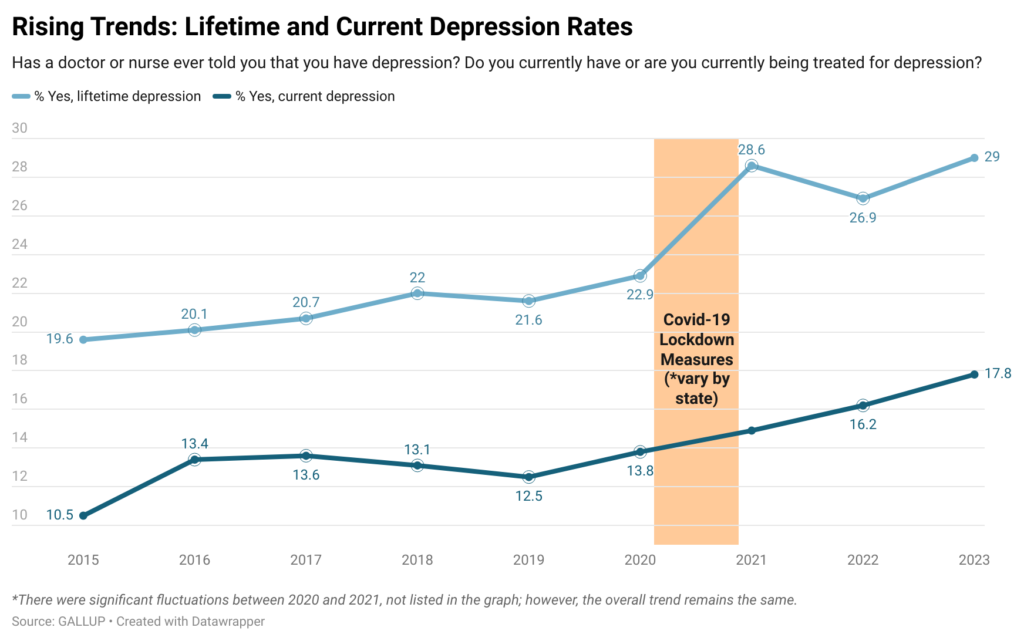
These trends correspond with overarching mental health issues exacerbated by the pandemic. Depression rates increased as people encountered isolation, financial strain, and various upheavals, exacerbating the psychological impact of gun violence on youth. The growing prevalence of anxiety, sadness, and trauma among students affected by mass shootings was apparent prior to the pandemic; nonetheless, the intersection of both crises has exacerbated the issue significantly.
Protecting Future Lives
The increase in gun violence in the United States and resulting psychological, educational, and economic devastation calls for urgent action. The widespread increase of gun violence in the United States, exacerbated by its severe psychological and educational repercussions, necessitates immediate intervention. Gun deaths are the predominant cause of death among children and adolescents, eclipsing vehicular and drug deaths, underscoring the need for reform. Long-term educational losses and rising rates of despair and anxiety highlight the multifaceted toll gun violence has on our society. While families and communities suffer ongoing loss and hopelessness, students exposed to the trauma of school shootings experience interrupted academic development and fewer opportunities for higher education.
It is time to address this crisis with concrete solutions. Nationwide implementation of stricter gun legislation, emulating the accomplishments shown in states such as California, is imperative. Universal background checks, prohibitions on assault weapons, and stringent “red flag” legislation are crucial for preventing firearms from being acquired by inappropriate individuals. Furthermore, continuous investment in mental health services for educational institutions and communities is essential for resolving the psychological trauma resulting from gun violence. We cannot delay action until more catastrophes occur. The information, narratives, and trends articulated necessitate a cohesive and immediate reaction. By emphasizing safety, mental health, and education, we can shield future generations from the destructive cycle of gun violence and provide them the chance to live, learn, and flourish in a more secure environment.