
Fencing is weird and complicated. Suspected cheating at the highest level is making it more so.
You may have tuned into the Olympics this year, or have at least seen a few of the viral moments during the festivities, including Australian breakdancing sensation Raygun or Turkish sharpshooter Yusuf Dikeç for his nonchalant demeanor. Although the games’ popularity has waned throughout the years, some find joy in watching the games for the ceremonies, rooting for their home country, and for some (including myself), spectating odd sports.
I started watching sport fencing during the 2016 Rio de Janeiro Summer Olympics through short videos and highlight reels online. Something about it fascinated me – it was weird. Two people were wearing gear akin to an astronaut suit or a beekeeper’s garb, holding a steel sword with an incredibly thin and bendy blade, and were trying to hit each other. Both combatants have a wire protruding from underneath their jackets, almost tethering them to the playing field, and what followed was something I have never seen before… and I loved it. Through the confusion and bewilderment of what I had just witnessed, I thought to myself, “I think I found my new favorite odd sport.”
As I started to watch more fencing in my own time, I discovered that this incarnation of the sport has been in every modern Olympic competition, starting with the 1896 Games in Athens. Originating in the Byzantine Empire in the late sixth century, fencing evolved into a sport with its introduction to the nineteenth-century military training regimen. Today, modern sport fencing has three disciplines–foil, épée, and sabre–each with its own unique history, techniques, and rules.
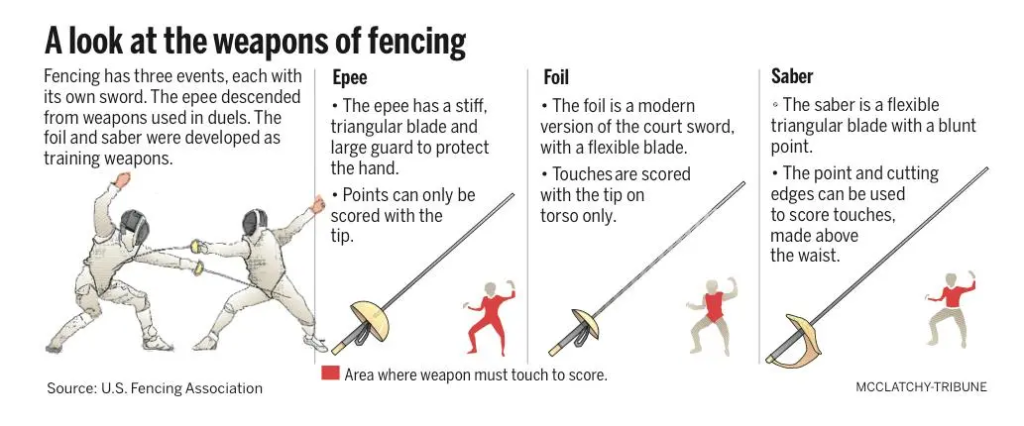
For example, not all hits are valid. Épées and foils are thrusting weapons, meaning you can only use the tip of the blade to score. On the contrary, sabres are slashing weapons, allowing you to use the entire length of the blade, making it the most aggressive and fast-paced out of the three. Another distinctive rule of foil and sabre fencing is called right of way, or priority. If two athletes were to successfully hit each other in less than half a second, then it would come down to priority to determine who gets the point (in épée, both players would receive a point). Right of way can be gained through attacking before your opponent, parrying (deflecting) your opponent’s blade, but also lost by missing, hesitating, or being parried. Priority may alternate between players multiple times, or once throughout a round. This may sound confusing because it is–sometimes referees may see and call the same play differently.
Further advancements in technology eventually led to the development of an electronic scoring system, with all disciplines adopting its use by the 1980s. While this breakthrough put less bias and error into scoring, a consequence of its implementation was that fencing got much faster, with hits sometimes occurring milliseconds apart. Emphasis was now being placed on speed rather than traditional form and bladework, which helped it break away from its historical roots and limitations.
Despite fencing being scored electronically with specialized equipment, a more accurate description would be to call the scoring electronically-assisted. Referees were very much still required, particularly for foil and sabre. Helping greatly with single touches, when both players made contact within the short timeframe, it would still be left up to the referee’s discretion. With the increase in the speed at which the sport is played, the referee’s input has become even more valuable, with not many safeguards to prevent fraud.
A forty-eight-minute YouTube investigation, titled “Fencing’s Biggest Open Secret” highlighted numerous suspicious incidents in recent memory. The video was uploaded by “ponce de león fencing,” an anonymous former Olympian who is deeply worried about the sport’s future. Although retired from fencing, she remains an avid follower of sabre and has expressed frustration over the lack of decisive action being taken to address these issues.
Vasil Milenchev, a seasoned referee from Bulgaria was accused of giving unfair advantages to fencers from his home country at some of the world’s most prestigious competitions. At the Kuwait Satellite World Cup in 2023, replays reveal Milenchev (a referee in the tournament), coaching a Bulgarian fencer, violating FIE (International Fencing Federation) law.
Milenchev was also suspected of providing preferential treatment to certain fencers, specifically Mitchell Saron from the United States. Saron performed abnormally well while Milenchev reffed his pre-elimination matches, greatly advantaging him to qualify for the 2024 Olympics. Additionally, Saron was assigned to Milenchev an unusually high number of times during tournaments.
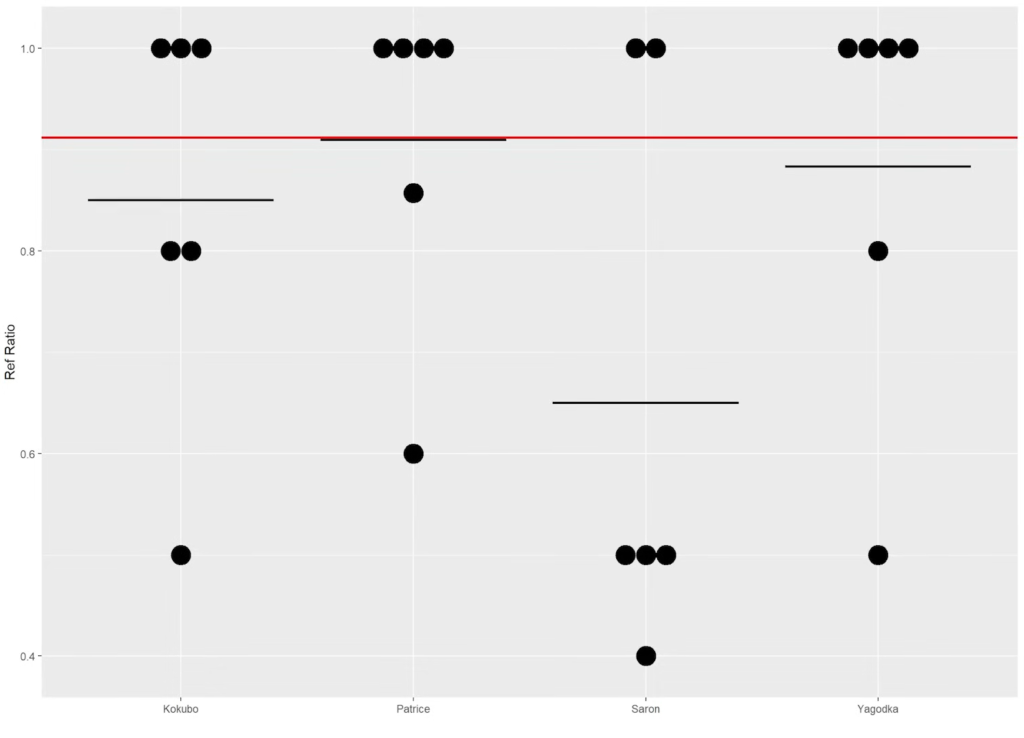
“ponce de león” calculates a “Ref Ratio,” defined as the number of unique referees encountered divided by the number of rounds fenced, for six other athletes comparable to Saron’s skill level, averaging around 0.9118. Since this value is close to one, these fencers did not encounter the same referee twice within this tournament. However, Saron had a ratio close to 0.6500, meaning he had been assigned Milenchev much more frequently in the same competition. Mitchell Saron performed more than four times worse anytime Milenchev did not referee him.
Kuwaiti fencer Yousef Alshamlan’s coach, former FIE referee Marco Siesto allegedly colluded with other referees to help Alshamlan make it to the 2020 Olympics. Video footage from the Budapest World Cup in 2021 shows Siesto making comments to the referee before the match begins. Though difficult to hear through the loud music and other background noise, the uploader affirms that the coach implied that Anstett [Alshamlan’s opponent] cannot qualify and should not win. Other shady behavior such as intimidation from Siesto can be seen throughout this match. Despite some dubious calls in Alshamlan’s favor, Anstett would end up victorious.
Aside from more dishonest reffing, “ponce de león” theorizes that Alshamlan has participated in match-fixing to qualify for the 2024 Olympics.
Attention was also placed on Tatiana Nazlymov, a member of the USA women’s sabre team. The Nazlymov fencing dynasty has roots in sabre, with her grandfather, Vladimir, becoming an Olympian in the late sixties and seventies for the USSR. Tatiana’s father, Vitali runs a fencing club in the Bethesda, Maryland area.
But the family’s record has not been clean. Vladimir Nazlymov has been in hot water for recruitment inducement, or swaying athletes to attend a particular institution, leading to his retirement from Ohio State University. Valiyev Fikrat, an Azerbaijani referee, was employed as a mentor at the Nazlymov Fencing Foundation but would go on to referee Tatiana’s matches with less than surprising results. Interestingly, “ponce de león” states that Tatiana performs much better in international competitions, rather than domestic ones, despite the latter being much easier.
It doesn’t end there. Corruption between Vladimir Nazlymov and Valiyev Fikrat was also speculated. In 2019, Nazlymov would become coach of Uzbekistan’s national sabre team, and Fikrat, still employed at Nazlymov Fencing, was under suspicion of giving Uzbek fencers help. “ponce de león” says that “this is not an isolated incident” and “comically bad calls are being made” in favor of Uzbekistan.



Pablo Torre, an investigative journalist, digs deeper into the stories of Mitchell Saron and Tatiana Nazlymov in his video, “Match-Fixing, the Oligarch and the Ivy League: Inside the Most Corrupt Sport at the Olympics”.
Saron’s personal coach, Oleg Stetsiv, is also Nazlymov’s coach. Stestiv also recruited Tatiana to the Princeton University sabre team. Torre also finds a staggering connection: Stestiv and Milenchev have both worked at the Nazlymov Fencing Foundation.
Fencing is not a popular sport, so it is understandable that some of these issues do not have widespread recognition. While relatively unknown to most in the world, for those who compete it means everything.
At the international level, many high level fencers and officials know each other, which has prevented these issues from getting fixed. Unfortunately, when wrongdoing is noticed and accounted for, punishments are not severe enough. USA Fencing tried to prohibit Milenchev from reffing Nazlymov and Saron, to no effect. Bans are rarely handed out.
Footage of these matches are extremely hard to come by as well. For such an “elite” sport that has its roots within the Ivy League, many of these world-class bouts are not recorded. Much of the evidence for this investigation had to be compiled from multiple different sources, many of them hand recorded from fencing enthusiasts.
Another reason is because many are afraid to voice their concerns. Russian-Uzbek oligarch Alisher Usmanov, currently sanctioned by the US, EU, and UK governments, is the four-term President of the International Fencing Federation.

Usmanov not only has relations with Russian President Vladimir Putin, but also International Olympic Committee President Thomas Bach. Usmanov has wielded incredible power over the FIE and the fencing scene and is not afraid to use that power for his own interests. In fact, Alisher Usmanov hand-picked Vladimir Nazlymov to coach the Uzbekistan sabre team.
But some are starting to speak out, including Marcus Schulz, a former sabre referee.
I will receive threats after this, you can be sure about that. I will get very ugly messages, maybe someone will threaten my family. These things will happen. But I am not afraid… somebody needs to start… maybe more will follow,” Schulz said to Torre in an interview.
Schulz also believes that half of the world’s top twenty referees are corrupt and the entire system needs to be brought down to be built back up.
Andrew Fishl, who runs the fencing YouTube channel CyrusofChaos has personally attested that three of his elite sabre fencing friends are retiring from the 2024-2025 season until the corruption is addressed and taken care of. Fishl has taken it upon himself to study the cheating pandemic in his own time through surveys and analysis.
While fencing has some pretty dire issues with integrity, it is not the only sport with these issues.
According to the United Nations, corruption in sports is worth $1.7 Trillion annually. Match-fixing, illegal betting, extortion, and doping were the most commonly committed crimes, especially in the sport of soccer, which the UN defined as “the most corrupt sport.”
Further research from INTERPOL–the International Criminal Police Organization–has revealed certain interesting trends. Each National Central Bureau Zone, loosely representing each continent, did not have an equal number of corruption investigations from 2018 to 2023. Europe was the most targeted region with 233 distinct cases, while the Caribbeans and Central America had only 5.
Some governments have promised to fight fraud, like many European Union member countries, with the Macolin Convention being signed into law in 2019. But legislation on the matter is few and far between. Worse yet, data on the topic is rarely made publicly available, which makes it difficult to gauge its effectiveness. Transparency is something that every sports governing body needs to work on in the future.
No matter which sport you may be a fan of, I hope that corruption does not ruin the games that we love so much.
Work Cited:
Fencing-Russians win second consecutive gold in women’s team sabre
Australian breaker Raygun says she felt ‘panic’ after public reaction to her Olympic performance
Shooting-Casual Turkish shooter goes viral, teammate says he earned it
Summer Olympics Poised to Have Record-Low U.S. Viewership
The fascinating history of fencing: From ancient duels to modern sport
Bay Area a fencing incubator that’s ‘exploding’
Sabre Fencing Team Final Olympic Games 1980 Moscow Highlights
Men’s Highlights | Orléans Sabre Grand Prix
Vladimir Nazlymov Olympic Profile
NCAA hits OSU fencing, women’s basketball and women’s golf with 4-year probation
Nazlymov, Vladimir Aliverovich Biography (Translated from Russian)
Match-Fixing, the Oligarch and the Ivy League: Inside the Most Corrupt Sport at the Olympics | PTFO
Treasury Targets Russian Financial Facilitators and Sanctions Evaders Around the World
Alisher Usmanov meets the President Thomas Bach at the International Olympic Committee
Analysis of patterns and trends in competition manipulation in sport global data: 2018–2023
UN: Corruption in Sport Worth $1.7 Trillion Annually
The Convention on the Manipulation of Sports Competitions (the Macolin Convention)
]]>

Love Scams Gone Viral
Since bots are not real accounts, they can be made, run, and send messages automatically. Because they are so easy to make, they make up a large portion of all the accounts in these dating sites like Tinder, Hinge, and Bumble. Why are people doing this? Besides deliberately stealing the money of users, they are also used for human trafficking which we will reference later on. Using bots gives them much more accessibility and expands their influence to all users (Federal Trade Commission).
So this gives rise to another question. How do people fall for this and does this actually work for the scammers? Sadly, the companies of the apps and the users lose hundreds of millions every year. Most people who are targeted are older individuals but it isn’t uncommon for younger people to fall victim as well. This also gives these dating sites a bad image as they fail to regulate the amount of bot and scam accounts. Overall, this is bringing significant harm to both the company and the users within these apps.
Pig Butchering: The Dark Side of Romance Scams
What is “Pig Butchering” and what does pork have to do with dating scams? Well, pig butchering in this case has nothing to do with the meat industry. “Pig Butchering” is one of the darker effects of romance scams that involves illegal human trafficking and labor. This usually occurs in Southern Asian countries where people are tricked to perpetuate schemes against their will. The original term of “Pig Butchering”, comes from the act of fattening up a pig before essentially killing them for meat. This is a dark but accurate metaphor for what the scammers are doing (ProPublica).
Pig Butchering scammers use online dating sites like Tinder to target their victims. People who are using online dating apps are usually looking for a romantic partner. This makes them susceptible to trusting and fall victim to manipulation. After building trust, this leads to the butchering part of this scheme.
According to the Federal Trade Commission, some of their favorite lines to manipulate you into sending them money is ‘I, or someone close to me is sick, hurt, or in jail” which they use 24% of the time. Another way they use is by mentioning ways that they can teach them how to invest which occurs 18% of the time. In the same number of occurrences, they might mention that they are in the military or need help with an important delivery. Overall, these are some lines that they use regularly that can help you identify them as scammers.
Love Hurts…and Sometimes It Steals Your Savings
Falling in love is supposed to be a roller coaster ride filled with late-night conversations kicking up your feet in bed, screaming in your pillow out of frustration, and at times making you feel like life is worth living as it restores your faith in humanity. However, that isn’t the only roller coaster when it comes to how love can impact your life. Your bank account is also vulnerable to go up and down if you aren’t very careful.
Imagine this: you’re scrolling through your dating app, and there they are—your dream person. Your Romeo to your Juliet. They’re charming, bright, attentive, articulate, and just so happen to have a lucrative “investment opportunity” to pull you in. Spoiler alert: the only return on investment in this scheme is a heartbreak and financial devastation.
This is the cruel irony of pig butchering scams. These fraudsters don’t just con people out of money; they pull at your heartstrings first. They turn affection into ammunition, trust into a trap, and promises of forever into financial ruin. Consider the trauma and emotional scars as the interest you pay on your ‘financial investment’. With that being said, let’s dive into the raw, vicious aftermath for victims as we describe their pain through numbers and datasets.
According to this article from the Federal Trade Commission in 2023, nearly 70,000 people reported a romance scam with losses hitting a staggering $1.3 billion back in 2022. The median reported loss was $4,400, and it looked as if this was another area in which COVID-19 impacted our lives even after the end of the pandemic as these trends follow the spike in online dating app scams seen from 2020 and 2021. In that single year of 2022, cryptocurrency was responsible for 34% of the total reported financial losses whilst only accounting for 19% of the total number of reports. On the other hand, gift cards accounted for 24% of the total number of reports but only liable for 7% of the actual financial losses. This shows that if your partner ever brings up crypto or gift cards, close out the app IMMEDIATELY. Ok, on a more serious analysis, this proves that cryptocurrencies’ varying values is an extremely risky ‘investment opportunity’ and will hit you the hardest if you fall for it. You’re a lot more likely to get trapped using gift cards but don’t worry, even if you do fall for it, you shouldn’t be losing too much money. One last thing to note from this article is that just because you’re young and know how to navigate the internet better than the millennials and boomers, it doesn’t mean you’re not as susceptible to these scams. If anything, reports show that younger people are actually more likely to fall victim to these schemes; specifically, sextortion. Scammers who convince you to share explicit photos will in turn threaten to share them online if you don’t pay up. People aged 18-29 were over six times as likely to report sextortion than people 30 and over. So, the age-old saying of “be careful of what you put on the internet or else you’ll fall into a sextortion scheme on an online dating app” still stands to this day.
In this graph created with data from the Internet Crime Complaint Center (Federal Bureau of Investigation), we look specifically at confidence/romance fraud under all types of fraud in the U.S.. It is evident that COVID-19 caused a massive surge in the sheer amount of money these con artists robbed people of. 2019’s $475 million already seems like an insurmountable amount, but it pales in comparison to 2021 when this number doubles to $956 million. However, the one silver lining would be that 2021 and the COVID-19 pandemic may just be an anomaly and will not continue the trend of increasing amounts of money lost with more reports of romance fraud itself. In 2022 and 2023, it looks as if we are slowly trending back to the pre-pandemic number of fraud cases, especially highlighted in the second part of the graph that shows the number of romance fraud cases.
Ok, online dating Scams are extremely dangerous, we get that. How’s it being dealt with by law enforcement?
Well, there are laws that will help you if you ever do get caught up in an online dating scam. However, when it comes to these kinds of cases, the law is playing a game of catch-up with scammers who always seem one step ahead. Similar to online privacy and AI issues, technological innovation has simply outpaced our bureaucracy and there are many hurdles that law enforcement face when presented with this matter (maybe it has to do with the demographics of our policymakers; ok I’ll stop). The biggest hurdle is the fact that scammers often operate from jurisdictions where enforcement is lax and cooperation is limited at best. The anonymity provided by the internet and VPNs makes tracing these financial transactions a nightmare. Combine this with the number of reports and devastating financial losses, it’s like catching fish with your bare hands.
The Wire Fraud Act: The Scam Slayer (Sort Of?)
However, again, there is a silver lining. The Wire Fraud Act is the most frequently used policy in the legal fight against online dating scams. Although it was enacted in 1952 (again highlighting how potentially outdated our laws regarding technology could be), instead of targeting fraud transmitted via wire, radio or television, it is now the go-to law for prosecuting criminals operating through emails, texts and dating apps in this digital age. What makes this Act so notable is its broad wording. It doesn’t matter if the scammer is selling crypto or wants a $5 donation to their cash app. The only criteria they need to meet is if they used electronic communication to scam someone. And if they did, they’re in violation and will be personally escorted to their hefty penalties including fines and potential prison time, which will of course escalate the larger the case is and more parties involved. Sorry to end on a downwards note again, but like all things related to law, there’s an easy way for scammers to avoid this: operate outside the jurisdiction of U.S. law enforcement, which in simpler terms means scam Americans from a country with little incentive to cooperate with U.S. law enforcement. That’s why we’re here though, to prevent you from going down this trap in the first place so you can avoid the whole headache.
Wrapping It Up: Swipe Smart, Guard Up.
Online dating is supposed to be a modern fairytale; full of quirky messages, cringey interactions, and a place where underneath all the rubbish, you might find the hidden gem of true love. But as we’ve uncovered, the digital landscape can also hide some serious dangers within the bushes and the woods. Just like the werewolf licking his lips watching Little Red Riding Hood, there are many extroverted bots looking to steal your data and privacy, and other pig butchering scammers looking to fatten you up for financial slaughter. The stakes are high, but here’s the good news: awareness is your strongest armor, and you ain’t no Little Red Riding Hood. If you ever encounter a potential scammer on an online dating site, take a step back. Think to yourself “My, how perfect of a personality you have”, “My, how anonymous and vague you sound”, “My, what lucrative investment opportunity you have”, and critically analyze your partner at times.
By understanding the playbook and narrative scammers use—love bombing, emotional manipulation, too-good-to-be-true investment pitches—you can avoid this whole hellhole. Spotting red flags and trusting your gut can save you thousands of dollars but most importantly a heartbreak. While the legal system and dating platforms are playing catch-up to find these criminals, every new person aware of these scams is a win for all internet users. So whether you’re swiping for “the one” or just looking to chat, keep your eyes wide open and your wallet tightly shut. Love might be blind, but you don’t have to be.
Peace out,
The reasons range from horrific acts to accidental harming, yet the facts remain the same. In 2022 alone, 48,000 people died from gun violence in the U.S., averaging 132 per day, one every 11 minutes. With states allowing 18-year-olds to purchase firearms, since 2013 the death rate among children has increased 106% with ages ranging from 1-17. Gun violence was the leading cause of death in children and teens (ages 1-17), over car crashes, overdoses, and cancer. Out of the 48,204 individuals who died by gun violence, 27,032 were from suicide, 19,651 were from homicide, 463 were unintentional, 643 were with legal intervention and 415 were undetermined. Gun suicides reached an all-time high, increasing by 2.7% from 2021 to 2022 (JohnHopkins).
Eight out of ten murders in the U.S. in 2021 involved a firearm, the highest percentage since 1968, which is the earliest year the CDC has online records from. The gun death rates in the U.S. are much higher than in most developed countries, ranking 20th in its gun fatality rate in a study performed in 2018. The FBI found that there has been an increase in active shooter incidents between 2000-2021, with an increase of 3 incidents in 2000 to 61 in 2021 (Pew Research).
There has been an increased rate of gun violence throughout the United States, more specifically gun mortality. From 2005-2022, there has been a rapid increase in state mortality by gun violence over the last 20 years. Resulting in 8 states in 2022 having a rate over 21.18 (lighter red) compared to 0 in 2005. This map allows us to see the real difference that 20 years has made in the United States, more specifically related to gun violence and gun mortality.
Who is to Blame?
The Education Fund to Stop Gun Violence claims that the root of gun violence includes income inequality, poverty, underfunded public housing, under-resourced public services, underperforming schools, lack of opportunity, and perceptions of hopelessness and easy access to firearms by high-risk people (EFSGV).
With gun-related deaths taking the leading cause of death in 2020 over motor vehicle accidents, which had previously held this title: this switch-up can be due to two causes, the numerous legislative steps that have been taken to modify and improve safety in motor vehicles, and the lack of any federal legislation to respond to increased gun violence since 1994, which voted to ban assault weapons. June 24, 2022, the Bipartisan Safer Communities Act was signed into law which became the most significant federal legislation addressing gun violence since 1994; this act expanded background checks, expanded laws on barring those convicted of domestic violence from purchasing a firearm, created federal aid to states that implement “red flag laws” that aid authorities obtaining court orders to temporarily remove guns from those deemed dangerous and cracked down on the ability individuals to make illegal gun purchases (NIHCM).
The lack of sufficient gun laws is a fundamental contributor to the continued increase of gun violence across America. The accessibility and ability for individuals, such as children, to obtain such powerful weapons should be further contained and restricted. The enforcement of stricter gun laws is seen to be efficient in states that enact such laws, and therefore have a lower gun mortality rate and less gun violence in general. California, which has stricter gun laws has a homicide rate of 3.5/100,000 people while Mississippi, a gun-friendly state, has a homicide rate of 10.2/100,000 people (Joslyn Law Firm).
Mental Health Consequences and Educational Outcomes
The psychological consequences of gun violence in schools are severe and lasting. Studies conducted in Jefferson County, Colorado, documented an increase in fatalities among residents aged 14 to 18 during the 1999 Columbine High School massacre in both suicides and accidents. Analyses of healthcare providers located within five miles of an affected school show a rise of 21.3% in antidepressant prescriptions among those under 20 in the two to three years following fatal school shootings compared to the two years prior (Stanford Institute for Economic Policy Research).
These repercussions are not limited to mental health; educational outcomes are adversely affected. Affected students in a Texas study experienced up to a 12.1% increase in absenteeism. Such dips in attendance compromise academic advancement, which results in performance and standardized test score reductions. Experiencing a school shooting more than doubles the chance of needing to repeat a grade in the following two years (SIEPR). Rates of high school graduation declined by 3.7%, and college enrollment rates declined by about 10%. With these students 17.2% less likely to attend a four-year college and 15.3% less likely to get a bachelor’s degree by their late 20s, the long-term picture is also alarming.
Pandemic Blues?
The COVID-19 pandemic serves as a significant turning point in the realm of gun violence and its effects on mental health, particularly among youth. The overall rise in U.S. gun fatalities during this period underscores a concerning trend: deaths among those under 18 escalated by 50% within two years, increasing from 1,732 in 2019 to 2,590 in 2021. In 2021, overall gun fatalities hit a record 48,830, indicating a 23% rise since 2019 (Pew Research). Mass shootings experienced a significant increase throughout the pandemic. In 2020, the overall number of such occurrences surged by 46.5%, with July 2020 documenting 88 mass shootings—more than twice the figures for the same month in 2019 and 2018. A Harvard Medical School event study analysis anticipated an extra 343 mass shootings over 15 months following April 2020, highlighting the pandemic’s contribution to worsening this crisis.
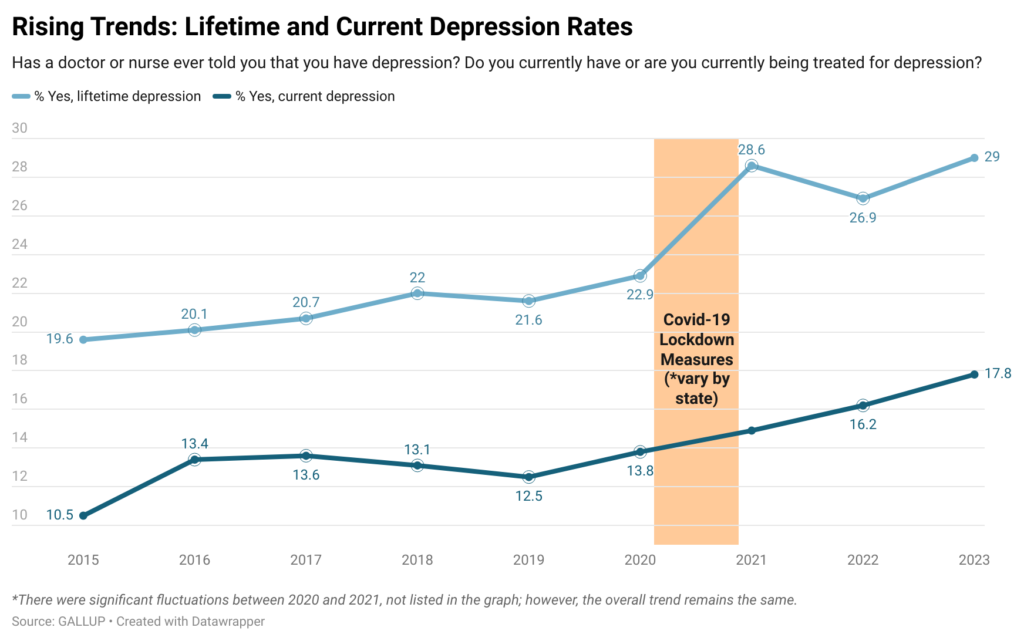
These trends correspond with overarching mental health issues exacerbated by the pandemic. Depression rates increased as people encountered isolation, financial strain, and various upheavals, exacerbating the psychological impact of gun violence on youth. The growing prevalence of anxiety, sadness, and trauma among students affected by mass shootings was apparent prior to the pandemic; nonetheless, the intersection of both crises has exacerbated the issue significantly.
Protecting Future Lives
The increase in gun violence in the United States and resulting psychological, educational, and economic devastation calls for urgent action. The widespread increase of gun violence in the United States, exacerbated by its severe psychological and educational repercussions, necessitates immediate intervention. Gun deaths are the predominant cause of death among children and adolescents, eclipsing vehicular and drug deaths, underscoring the need for reform. Long-term educational losses and rising rates of despair and anxiety highlight the multifaceted toll gun violence has on our society. While families and communities suffer ongoing loss and hopelessness, students exposed to the trauma of school shootings experience interrupted academic development and fewer opportunities for higher education.
It is time to address this crisis with concrete solutions. Nationwide implementation of stricter gun legislation, emulating the accomplishments shown in states such as California, is imperative. Universal background checks, prohibitions on assault weapons, and stringent “red flag” legislation are crucial for preventing firearms from being acquired by inappropriate individuals. Furthermore, continuous investment in mental health services for educational institutions and communities is essential for resolving the psychological trauma resulting from gun violence. We cannot delay action until more catastrophes occur. The information, narratives, and trends articulated necessitate a cohesive and immediate reaction. By emphasizing safety, mental health, and education, we can shield future generations from the destructive cycle of gun violence and provide them the chance to live, learn, and flourish in a more secure environment.
]]>