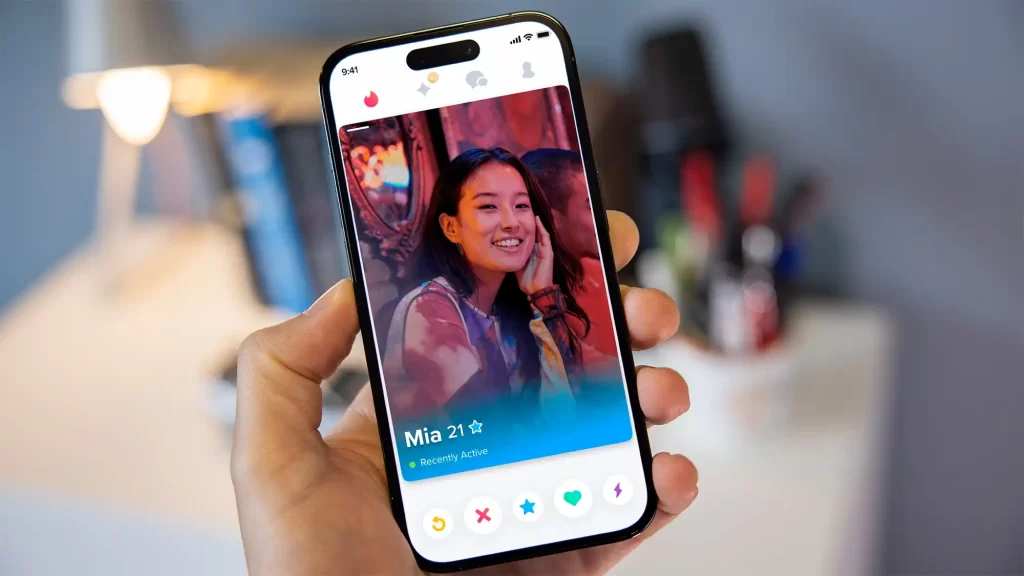
A Growing Concern for Safety
I f you’re an average person with a smartphone, you’ve likely heard of Tinder. Maybe someone you know has told you about it, or you’ve experienced it first hand yourself. Whatever opinion you hold about the app, swipe with caution. Tinder and its match-making counterparts may be contributing to a dark trend. These apps offer a new platform for malicious users to sexually harass others with little accountability. Women are the primary victim of this kind of behavior, with men being the primary perpetrator.
Dating is hard enough these days, and online dating apps may not make it any easier. A study done in 2017 by the PEW research center has shown that 20% of women, compared to a disproportionate 8% of men, have been sexually harassed on an online dating platform. With dating-app usage increasing steadily since 2015, this new way of match-making is sought out by many individuals from all age ranges, the majority of whom are under 30 years old. With activity increasing, the more necessary it is to crack down on this unacceptable behavior.

Tinder Trauma
The most popular apps among this demographic are Tinder, Bumble and Hinge. Sexual harassment on these apps can range in severity. To name a few, users receive unwanted sexual comments, images, and threatening messages. They also experience continued contact after expressing disinterest. The standards were already low, but asking to not send an unsolicited “dick pic” to a complete stranger would be the bare minimum. I guess I was wrong.
If an encounter occurs outside of the app, the trends are even more concerning. A study from Brigham Young University College of Nursing in Utah found that victims of dating app sexual assault were more likely to be strangled, 32.4% compared to 21.5%, and more likely to be a college student 22.2% compared to 16.5%. As far as the perpetrator goes, they were more likely to use a weapon, 11.0% to 9.1%, and more likely to use restraints, 5.2% to 4.1%.

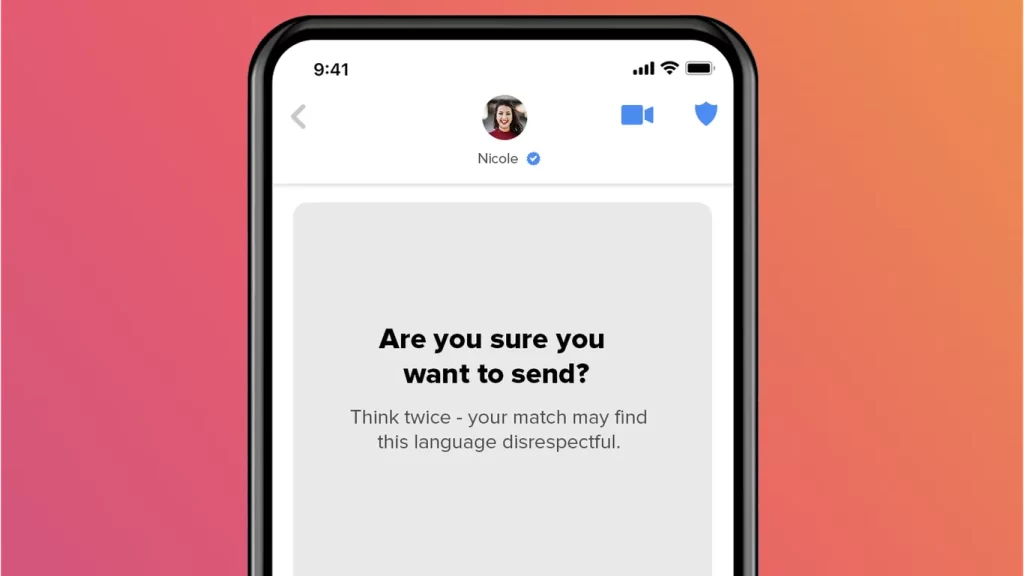
Tinder makes a disappointing attempt to discourage harassment and bullying on their app. Users are prompted to select “Yes” to bypass the warning or “No” to delete the message. Tinder tries to curb offensive messages
In terms of injuries, dating app sexual assault cases were overall more violent compared to those that were not facilitated by dating apps. Dating app cases had a higher frequency in genital injuries, 50.2% compared to 38.8%. For non-genital injuries, the frequency was 71.4% compared to 64.6%. The most shocking part, “Male perpetrators were involved in all dating app sexual assault cases”. A more recent study done in 2021 by PEW research center found that women see sexual harassment online as a major issue, compared to only 48% of men. I can see why.
These instances of sexual harassment should not be a “necessary evil” of dating apps. With being an asshole getting increasingly easier with the invention of the internet, safeguards need to be put in place for the people who aren’t. This is especially important in sexual harassment situations that can cause lifetimes of trauma. Until these apps take some accountability for the abuse that occurs, use caution while swiping, and tell your friends too.
LGBTQ+ Harassment
The harassment goes beyond gender. Unless you live under a rock, you know members of the LGBTQ+ community are constantly under intense criticism by politicians and podcast bros alike. From drag queens “exploiting” the youth (reading books to them while clothed) or children’s authors “indoctrinating” 4th graders with “sexually explicit content” (Tina the Turtle has two mommies), the propaganda perpetuating the narrative that all LGBTQ+ individuals are pedophiles continues to snowball out of control. (Statistically, most pedophiles identify as heterosexual, not to point the finger).
You’re on Tinder. What do you expect?
Online dating apps have a major problem with sexual harassment—but solutions must start offline
If you’re one of those rare people that have a brain and a sense of common decency, you know that individuals just want to love one another peacefully without being harassed. Yet for many, this simple desire is made impossible by a society determined to make them feel like outcasts. Dating apps have been a large part of LGBTQ+ people finding love and a community, which may be more comfortable due to the fact that it exists online and it can be easier to hide in situations where coming out is not an option.
Finding acceptance has been a longstanding issue when it comes to the mental health of those in the LGBTQ+ community, so the introduction of dating apps that cater to their needs has been truly instrumental in lowering rates of suicide and crisis. According to a survey by the Harris Poll, LGBTQ+ adults are more likely to say Tinder, a popular dating app, is “fun” or “hip” which indicates positive feelings attached to the app. For a community that has long faced marginalization, these digital spaces are doing more than connecting people; they’re helping build a sense of mutual enjoyment in life.
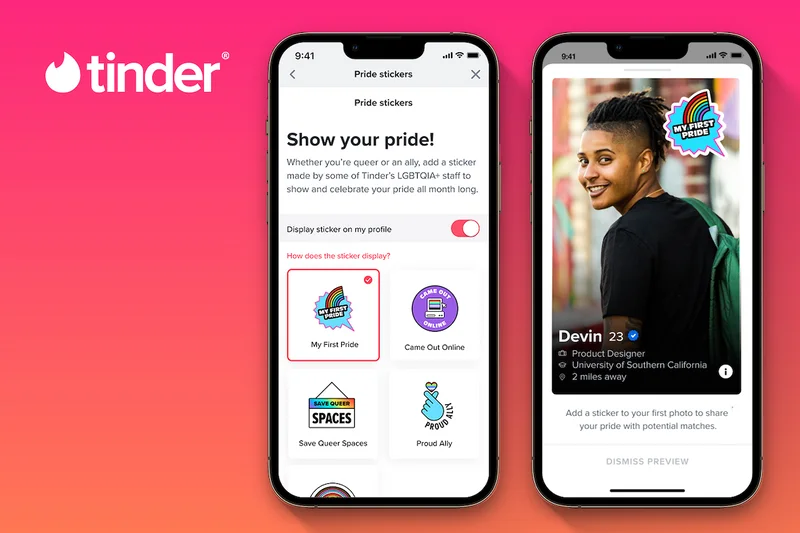
Tinder adopts pride stickers to promote inclusivity
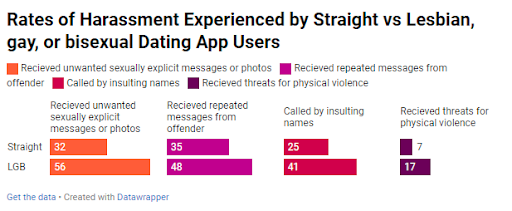
Even with all the good that dating apps and online spaces have done for the LGBTQ+ community, harassment is still a massive problem, a lot of it mirroring the verbal harassment and threats of violence LGBTQ+ people face outside of cyberspace. For a lot of people, these platforms are supposed to be a safe place to connect, but they often fall short. A report by Pew Research shares stunning statistics from only LGB online dating users that truly capture how unbalanced harassment is between them and their straight counterparts.
In this study, nearly half of these users have reported continued contact by a match after they said they weren’t interested, compared with the 35% of straight individuals surveyed. This can take the form of stalking, creating new accounts to continue contact, or harassment on social media accounts. For this group of people, reporting harassment to the company itself often feels like shouting into a void, and many LGBTQ+ users are left feeling unsupported and unsafe.
Swipe With Caution
Moderation efforts by bots or artificial intelligence help, but are still not a perfect solution. What’s more, those who sexually or violently harass users are unlikely to face legal consequences
in a timely manner, as with a lot of cases involving LGBTQ+ individuals. Platforms such as Tinder and especially Grindr, which is geared toward gay men, have a responsibility to their users to
ensure that their terms and conditions are held firmly by everyone.
Despite their pledges for safety, many dating companies continue to fall short. A now famous case against Grindr, Herrick v. Grindr, highlights the company’s poor regulations for duplication of accounts, which can be interpreted as stalking. Matthew Herrick, the Plaintiff, was continuously harassed by a former partner who pretended to be him on multiple occasions. According to Herrick, the fake profiles created by the partner communicated with other men on the platform, falsely informing them of a grotesque interest in rape fantasies and role play. The partner also invited the men that were seemingly being “seduced” back to Herrick’s home and place of employment without his knowledge for sexual intercourse.
All things considered, dating apps have truly been a lifeline for the LGBTQ+ community, providing spaces to connect, find love, and foster a sense of belonging in a world that so often rejects their pleas for acceptance. These platforms have positively impacted mental health, reducing feelings of isolation and even suicide rates. However, the undying harassment faced by LGBTQ+ users both online and offline continues to suffocate these benefits. Cases like Herrick v. Grindr expose dangerous flaws in moderation and policy enforcements that leave users vulnerable to stalking, impersonation, and abuse by known partners or unknown strangers.
To truly support LGBTQ+ users, online dating sites need to go beyond their common, lazy, surface-level efforts, implementing stronger protection for users, and ensuring that reports of harassment are not just brushed under the rug and thrown into a file cabinet in the deep of a high rise. While these spaces have the potential to be havens of connection and common ground, only through careful rebuilding and policy upholdings will they have the full trust of their loyal LGBTQ+ users.
The Gaps in Online Safety
Unfortunately, the internet can be a grim place. It has offered an avenue for people to hide behind the accounts they create. People have online personas that make it impossible to determine their true intent. They may not disclose their identity or lie about it, making it extremely difficult for them to be held accountable. Their account gets banned, so what? They make a new one with another email and continue to harass whomever they want. Just look at this Forbes Ranking on Safety, Tinder comes in with a whopping 97% negative review on safety and privacy features, followed by Hinge’s 95%, and the Bumbles’ modest 91%. What is going on here?
In an article written by Time, Tinder and Hinge in their terms of use, yes their terms of use that no one reads, asks users to affirm they aren’t a sex offender, or don’t have any sex related or violent felonies. With no background checks on any of these platforms, I think the violent sex offenders will just hit agree like everyone else.
Tinder and Bumble have features that monitor conversations checking for explicit images or inappropriate language. All three platforms have features where you can ban and report users, but it is unclear how easy users can make a new account. These “regulations” are not enough. On top of the perpetrators, the platforms need to be held responsible for the safety of their users.
This article was written and edited by Nicole Diaczun, Erica Kerman, Amelia Oakley, Grace McKissock, and Humza Chaudhri.
]]>Welcome back to yet another episode of Two Peas in a Podcast. Tune in each week to see Binghamton University students Nicole Diaczun and Amelia Oakley chat about the way young adults interact with technology!
Season 1, Episode 1: Swiped Out – The Shallow Side of Tinder
In this episode, Nicole and Amelia poke fun at the superficiality of Tinder. Through sharing some personal experiences and the hard facts, our wonderful hosts attempt to warn impressionable users about the risks posed by dating apps.
]]>